









The best Sentry alternatives & competitors, compared


Contents
Sentry is one of the most widely-used error tracking tools on the market, and for good reason. It's mature, reliable, and most developers have used it at some point.
But Sentry isn't the only option. Whether you're looking for deeper product context, a more generous free tier, or a tool that combines error tracking with analytics and session replay, there are strong alternatives worth considering.
In this guide, we compare the best Sentry alternatives, including tools that go beyond traditional error monitoring to help you understand who is affected and why it matters – not just what broke.
1. PostHog
- Founded: 2020
- Similar to: Sentry, LogRocket
- Typical users: Engineers and product teams
- Typical customers: Mid-size B2Bs and startups
What is PostHog?
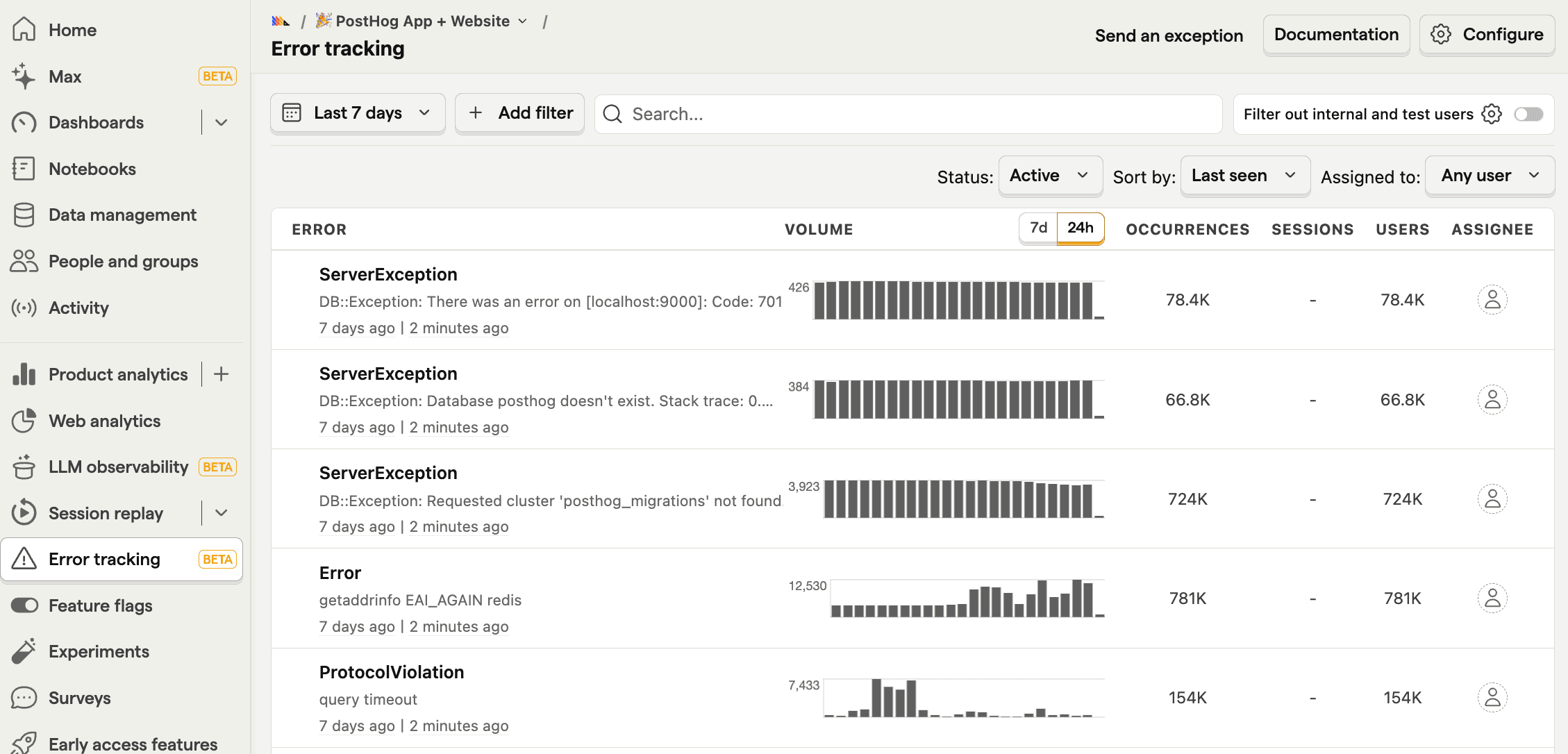
PostHog (that's us 👋) is an all-in-one platform combining error tracking, session replays, product analytics, web analytics, A/B testing, feature flags, user surveys, LLM observability, and more into one product.
This means it's not only an alternative to Sentry but also tools like Amplitude and LaunchDarkly.
Key features
Error tracking: Capture errors and exceptions. Provide stack traces to debug issues. Correlate with product usage data.
Session replays: View exactly how users are using your site. Includes event timelines, console logs, network activity, performance monitoring, and 90-day data retention.
Product analytics: Custom trends, funnels, user paths, retention analysis, and segment user cohorts. Also, direct SQL querying for power users.
Feature flags: Rollout features safely with local evaluation (for faster performance), JSON payloads, and instant rollbacks.
A/B tests: Optimize your app and website with up to nine test variations and track impact on primary and secondary metrics. Automatically calculate test duration, sample size, and statistical significance.
Surveys: Target surveys by event or user properties. Templates for net promoter score (NPS), product-market fit (PMF) surveys, and more.
How does PostHog compare to Sentry?
Main differences between PostHog and Sentry
- PostHog offers 100k free errors and 5k free recordings per month vs Sentry's 5k errors and 50 recordings on the free tier.
- PostHog ties every error to user sessions, product analytics, session recordings, and feature flags. Sentry focuses on stack traces and performance monitoring.
- PostHog includes SQL querying and warehouse syncs to analyze product data directly; Sentry doesn't offer a built-in SQL workspace or first-party warehouse connectors.
- Sentry supports 100+ platforms including Unity, Unreal Engine, Rust, and Elixir; PostHog covers major web and mobile frameworks but has narrower SDK coverage.
Main similarities between PostHog and Sentry
- Both capture exceptions with detailed stack traces and environment context.
- Both recently launched logs and LLM observability features
- Both offer AI assistants: PostHog AI can be used for querying data and debugging; Sentry has Seer for automated root cause analysis and fix suggestions.
- Both integrate with GitHub, Slack, and popular CI/CD tools.
Why do companies use PostHog?
According to reviews on G2, companies use PostHog because:
It replaces multiple tools: PostHog can replace Mixpanel (product analytics), Fullstory (session replay), and Optimizely (feature flags and A/B testing). This simplifies workflows and ensures product data is all in one place.
Pricing is transparent and scalable: Reviewers appreciate how PostHog's pricing scales as they grow. There's a generous free tier they can use forever. Companies eligible for PostHog for Startups also get $50k in additional free credits.
They need a complete picture of users: PostHog includes every tool necessary to understand users and improve products. This means creating funnels to track conversion, watching replays to see where users get stuck, testing solutions with A/B tests, gathering feedback with user surveys, and monitoring errors.
Bottom line
If you're looking for error tracking and session replay, along with many more tools for making your product better, PostHog is a great alternative to Sentry. This is especially the case for startups and scale ups, thanks to PostHog's generous free tier.
Want to just try it? PostHog is free to start (no credit card needed) and it takes just one command to install. Seriously, that's it. Our AI setup wizard will do the rest.
2. Rollbar
- Founded: 2012
- Similar to: Sentry, Appsignal, Raygun
- Typical users: Developers, engineers, and operations teams
- Typical customers: Enterprise organizations, SaaS companies, and tech startups
What is Rollbar?
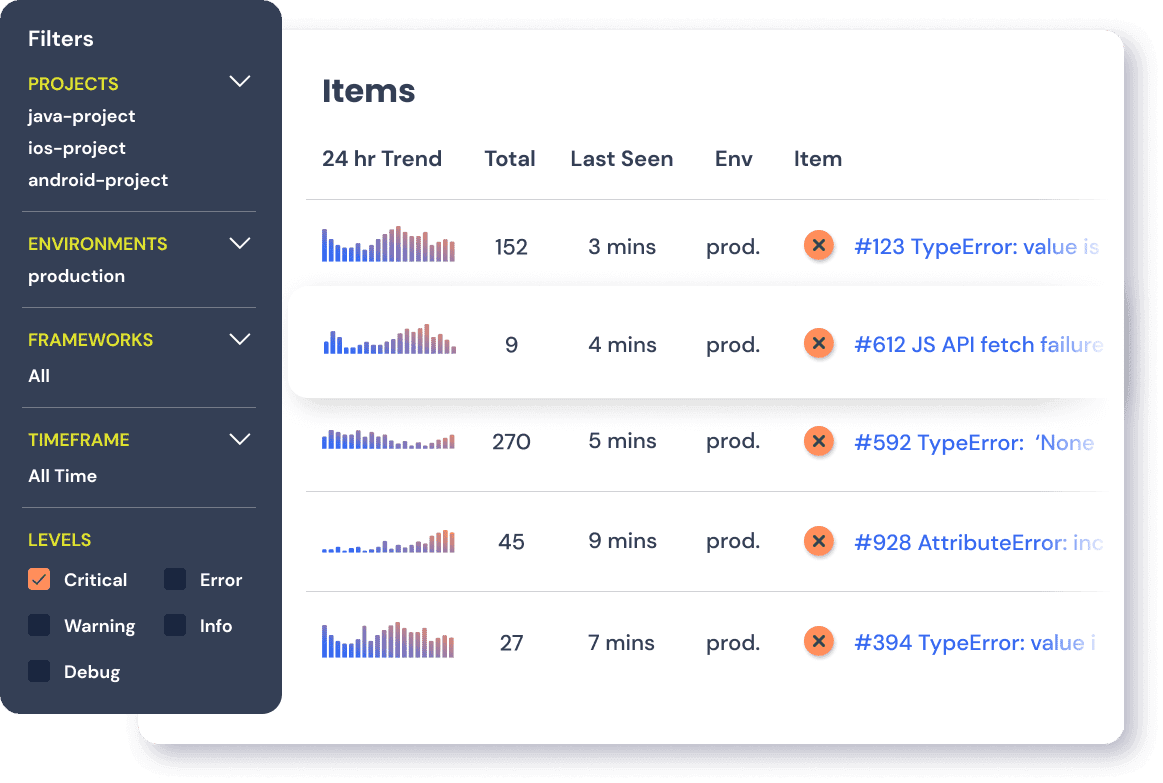
Rollbar helps teams find and fix errors in their code fast through real-time error tracking, issue management, and AI-assisted workflows. Their whole platform is designed to help teams quickly detect, prioritize, and resolve issues in their applications.
Key features
Error tracking: Real-time error detection with automatic grouping and issue tracking.
Alerting: Customizable alerting with notifications where you need them.
Error context: Detailed error context including stack traces, code, and telemetry.
Custom workflows: Use Rollbar's rules engine to trigger API or webhook-based actions.
How does Rollbar compare to Sentry?
Main differences between Rollbar and Sentry
- Sentry includes built-in performance monitoring and distributed tracing; Rollbar focuses purely on error tracking.
- Sentry offers a self-hosted open-source option; Rollbar is cloud-only and proprietary.
- Sentry's UI is built for large teams managing multiple projects; Rollbar's simplicity suits smaller setups.
- Sentry has a larger free tier (5k errors vs Rollbar's limited free plan).
Main similarities between Rollbar and Sentry
- Both provide real-time error detection with automatic grouping and notifications.
- Both integrate with GitHub, Slack, Jira, and CI/CD pipelines.
- Both support wide language and framework coverage.
- Both offer customizable alerting rules and workflow automation.
Why do companies use Rollbar?
According to reviews on G2, companies choose Rollbar for its:
Ease-of-use: Reviewers like that Rollbar makes it easy to track and monitor errors to ensure their apps are running smoothly.
Integrations: Rollbar integrates with the tools reviewers already use like Slack, GitHub, Jira, and more.
Customer support: Reviewers appreciate Rollbar's responsiveness to support requests and feedback.
Bottom line
If Sentry is too complex or expensive for your needs, Rollbar might be a great alternative to try.
3. Raygun
- Founded: 2007
- Similar to: Sentry, Rollbar
- Typical users: Development teams and SREs
- Typical customers: Ecommerce and media companies
What is Raygun?
Raygun is a full-stack monitoring platform focused on ecommerce and media companies.
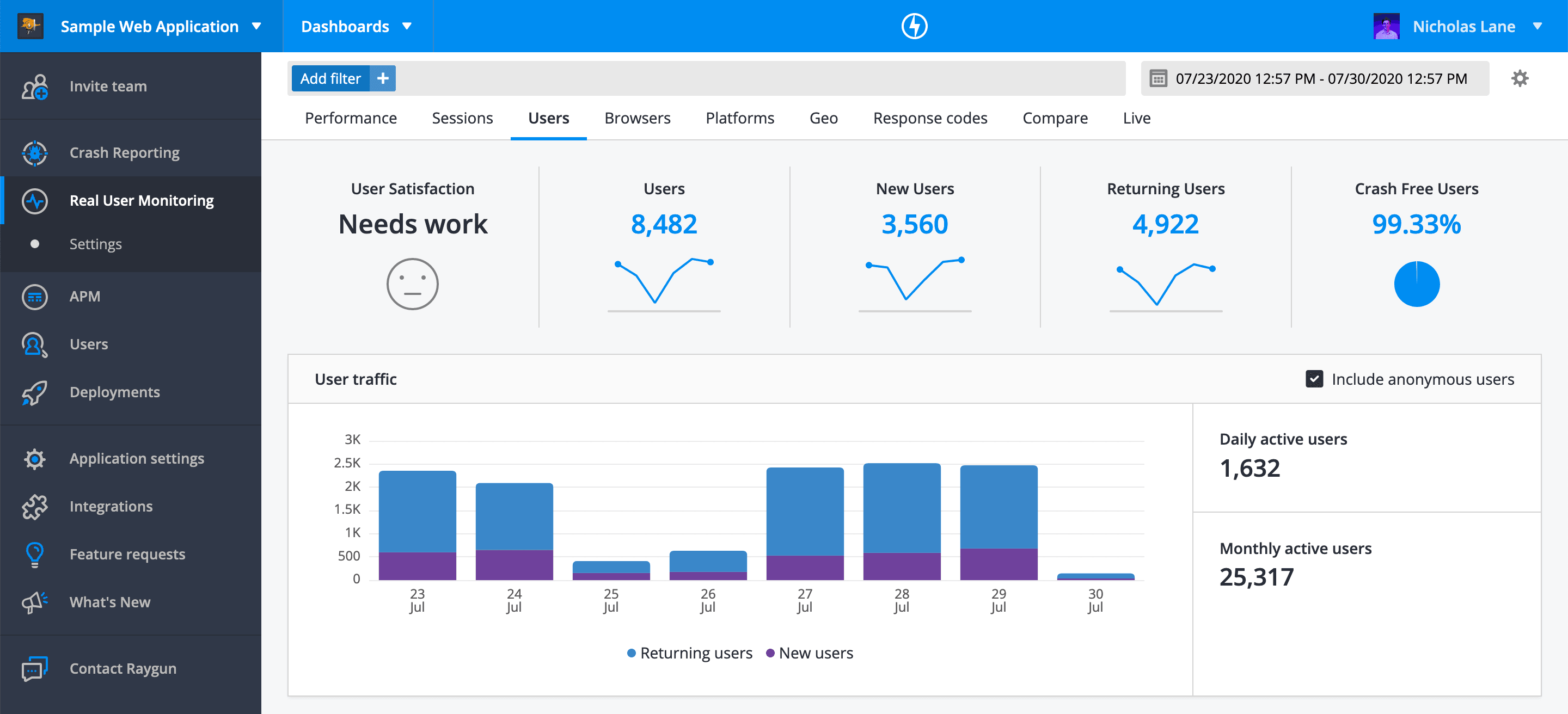
It provides crashing reporting, performance monitoring, and user experience insights. Its suite of tools enables teams to quickly detect, diagnose, and resolve issues across their entire tech stack. It's also built an AI error resolution system to help with this.
Key features
Error tracking: Real-time error and crash reporting with detailed stack traces and code-level insights.
Performance monitoring: Get insights into your app's performance for your users. Track metrics like Core Web Vitals and load times.
Application performance monitoring: Uncover backend performance issues with tracing and visualizations.
AI error resolution: Raygun's suite of tools has AI error resolution built in to make all of this easier.
How does Raygun compare to Sentry?
Main differences between Raygun and Sentry
- Raygun includes AI-powered error resolution; Sentry recently added Seer AI but it's an add-on.
- Sentry offers a free tier; Raygun only provides a 14-day free trial.
- Sentry is source-available (FSL) and can be self-hosted or used in the cloud; Raygun is subscription only.
- Raygun has a stronger focus on .NET and Flutter SDKs; Sentry has broader framework coverage.
Main similarities between Raygun and Sentry
- Both provide real-time crash reporting with detailed stack traces.
- Both offer application performance monitoring alongside error tracking.
- Both integrate with popular issue trackers and notification tools.
- Both support web, mobile, and backend environments.
Why do companies use Raygun?
According to G2 reviews, Raygun is chosen because:
Alerting: Reviewers like that Raygun helps them stay on top of issues in real-time. This helps them maintain a high level of satisfaction.
Stack traces: Raygun helps reviewers find the exact code or request that is causing an issue. Grouping also helps them figure out which issues are causing the most pain.
Simplicity: Compared to other tools, reviewers find Raygun easier to set up and use. They appreciate the UI Raygun has built.
Bottom line
If you're looking for a simple tool to do error tracking and performance monitoring, Raygun is one to try out. Their lack of a free tier makes them harder to recommend for small projects though.
4. Datadog
- Founded: 2010
- Similar to: New Relic
- Typical users: DevOps teams, IT, and software engineers
- Typical customers: Huge, cloud-native enterprises
What is Datadog?
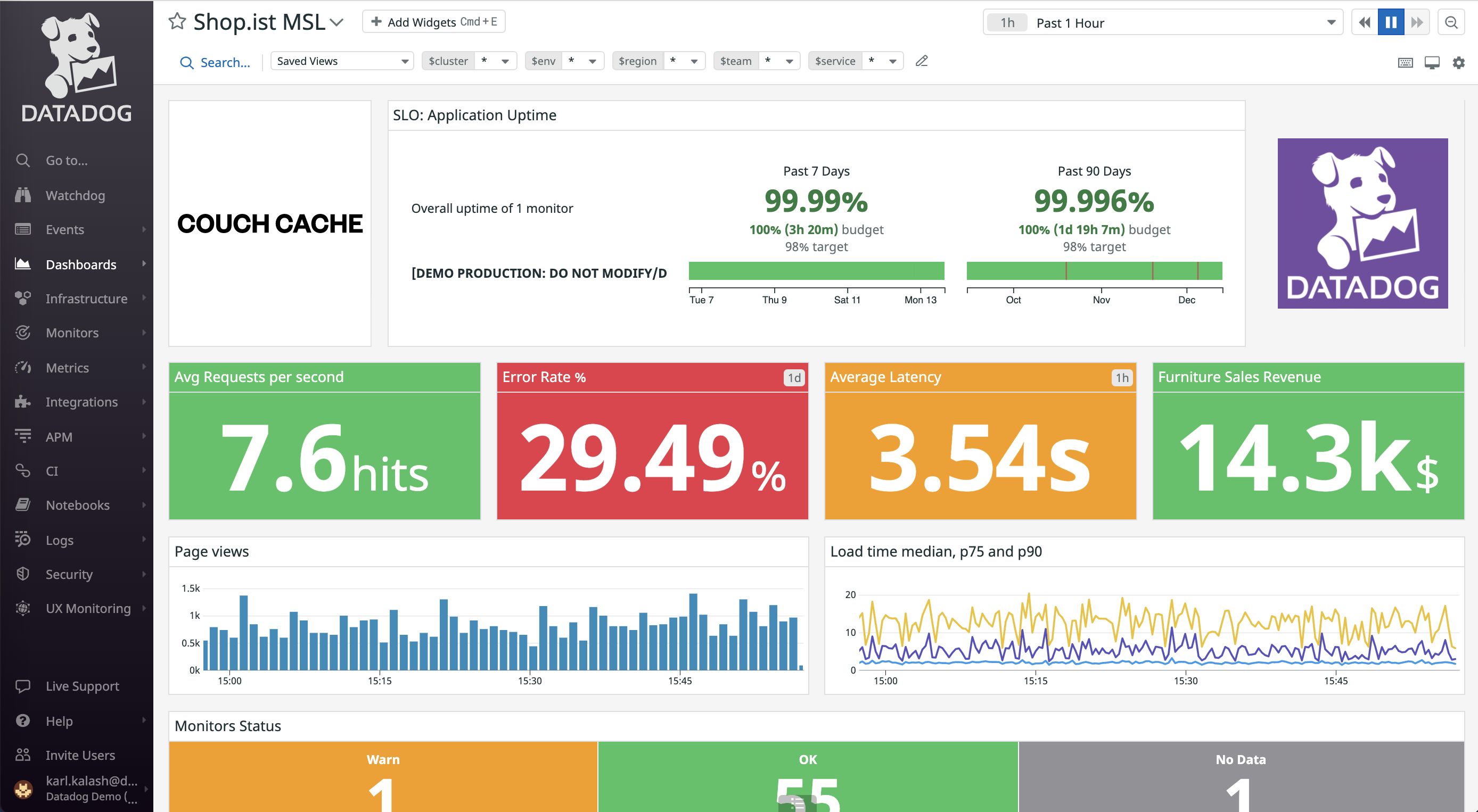
Datadog is a cloud observability and monitoring platform that provides real-time visibility into infrastructure, applications, logs, and network performance. It enables organizations to ensure performance, security, and reliability across their entire stack.
Key features
Performance monitoring: Monitor your app (and infrastructure) performance across your stack, from frontend to workflows to databases. Troubleshoot issues with distributed tracing.
Log management: Aggregate and analyze logs in real-time to correlate events, identify issues, and gain insight into system performance.
Infrastructure monitoring: Get visibility into your infrastructure's performance, health, and security across your cloud or hybrid environment.
Security and compliance monitoring: Ensure your data is secure and compliant with industry standards. Protect against reported vulnerabilities.
How does Datadog compare to Sentry?
Note: Although Datadog has a free tier, its 1 day data retention is not enough for real usage.
Main differences between Datadog and Sentry
- Datadog is a full observability platform covering infrastructure, APM, logs, and metrics; Sentry focuses on application-level errors and performance.
- Datadog's RUM includes replay-like functionality tied to backend traces; Sentry treats session replay as a separate product.
- Datadog pricing is enterprise-scale and can get expensive quickly; Sentry is more accessible for smaller teams.
- Datadog requires more setup and configuration; Sentry is faster to deploy for error tracking alone.
Main similarities between Datadog and Sentry
- Both provide real-time exception alerts and error grouping.
- Both integrate with popular frameworks, cloud providers, and deployment tools.
- Both support distributed tracing across microservices.
- Both offer team dashboards and notification integrations.
Why do companies use Datadog?
According to G2 reviewers, Datadog is chosen because:
Multi-product: From infrastructure monitoring to application performance monitoring to log management, Datadog has products for nearly every part of your stack. Reviewers also appreciate that all these products are interconnected.
Integrations: Reviewers claim that Datadog has integrations for "literally everything." This means it can hook into nearly every tool they use.
Depth: The amount of data Datadog can collect is huge. Along with their range of analysis tools, reviewers find it's super customizable to their needs.
Bottom line
For huge enterprises, Datadog is likely already on your monitoring radar. The main complaint is the cost, which might make other tools more appealing, especially for smaller teams.
5. New Relic
- Founded: 2008
- Similar to: Datadog
- Typical users: Engineers, DevOps, SREs, and IT Ops
- Typical customers: Enterprises, mid-market technology companies, and cloud-native organizations
What is New Relic?
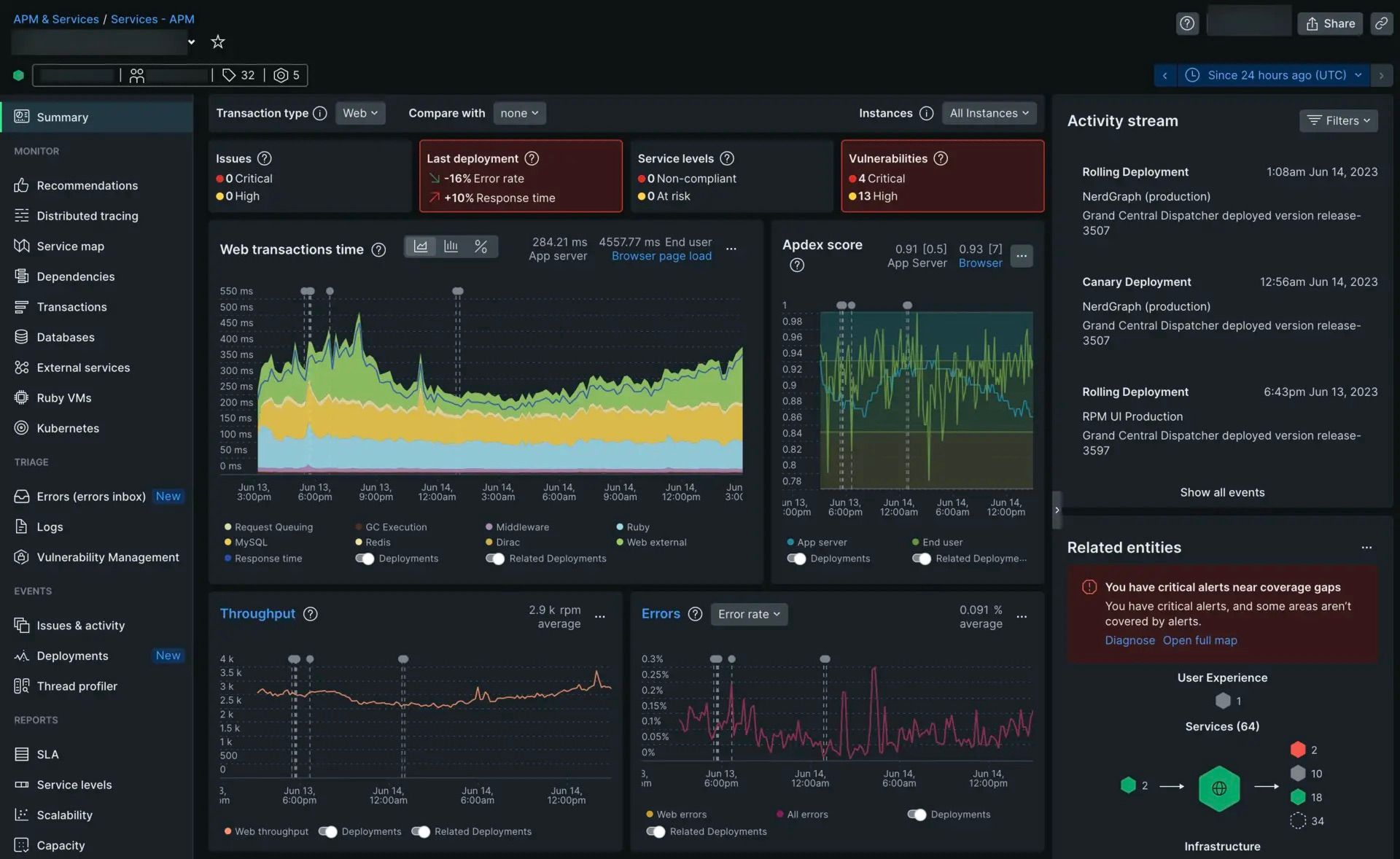
New Relic is a cloud-based observability and analytics platform that provides full-stack visibility into application performance, infrastructure, and user experience. It helps organizations monitor, troubleshoot, and optimize their software in real time, enabling proactive issue resolution and improved customer experiences.
Key features
Full-stack observability: Monitor applications, infrastructure, and digital experiences across your entire stack
Real-time monitoring: Track performance and errors with AI-powered insights and analysis
Log management: Aggregate and analyze logs with distributed tracing for quick troubleshooting
Integrations: Connect with over 780 tools and open source ecosystems
Flexible pricing: Usage-based pricing model with a free tier, makes it cheaper to get started with (than Datadog)
How does New Relic compare to Sentry?
Main differences between New Relic and Sentry
- New Relic offers full-stack observability including infrastructure monitoring; Sentry focuses on application errors and performance.
- New Relic has a more generous free tier (100 GB/month data ingest); Sentry's free tier is limited to 5k errors.
- New Relic uses AI-powered anomaly detection across all telemetry; Sentry's AI features (Seer) are focused on error resolution.
- New Relic supports 780+ integrations; Sentry has fewer but deeper developer tool integrations.
Main similarities between New Relic and Sentry
- Both provide real-time error monitoring with stack traces and context.
- Both offer performance monitoring and distributed tracing.
- Both integrate with popular CI/CD and collaboration tools.
- Both support web, mobile, and backend applications.
Why do companies use New Relic?
G2 reviewers like New Relic because:
It's all-in-one: Reviewers find that New Relic provides all the functionality they need to monitor their apps and infrastructure, as well as find issues and solve them.
It's easy to get started: Reviewers praise New Relic for how easy it is to set up and its pre-built queries and dashboards. This helps them get started quickly and transition into more complex use cases when needed.
Bottom line
New Relic is similar to Datadog: it has a ton of observability and monitoring features (along with the added bonus of a free tier). Definitely one to consider for enterprise DevOps and SRE teams.
6. LogRocket
- Founded: 2016
- Similar to: PostHog
- Typical users: Product managers, engineers, support teams
- Typical customers: B2B SaaS, B2C retail companies
What is LogRocket?
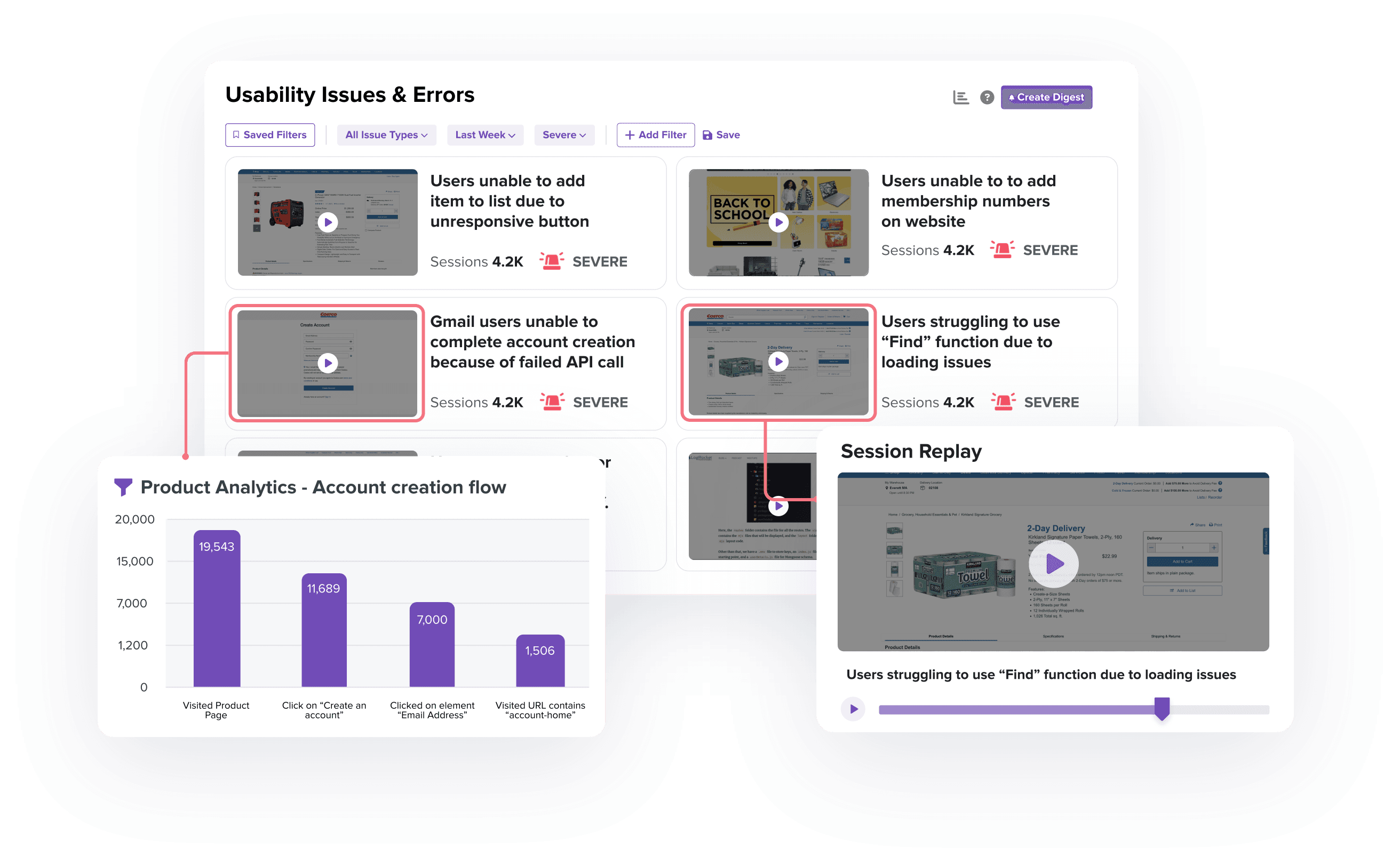
LogRocket is a product experience platform with product analytics, error tracking, session replay, and performance monitoring. It focuses on helping product managers, engineers, and support teams identify and fix issues.
Key features
Error tracking: Identify and triage the most impactful issues with JavaScript and network errors as well as stack traces.
Session replay: Understand exactly what users are doing on your site. See the screens they visit, places they click, as well as console and network logs, errors, and performance data.
Performance monitoring: Monitor frontend performance such as web vitals, CPU and memory usage, and network speed.
Product analytics: Capture usage data and visualize it with conversion funnels, path analysis, and retention charts.
How does LogRocket compare to Sentry?
Main differences between LogRocket and Sentry
- LogRocket emphasizes frontend debugging with visual session replays; Sentry focuses on backend and full-stack error monitoring.
- LogRocket captures user interactions, network calls, and console logs together; Sentry treats replay as a supplementary feature.
- Sentry is source-available (FSL) and can be self-hosted or used in the cloud; LogRocket is cloud-only and proprietary.
- Sentry has stronger backend error tracking; LogRocket is primarily frontend-focused.
Main similarities between LogRocket and Sentry
- Both detect JavaScript errors with stack traces and source maps.
- Both integrate with Slack, GitHub, and issue tracking tools.
- Both offer performance monitoring for frontend applications.
- Both help engineering teams reduce debugging time.
Why do companies use LogRocket?
According to G2 reviews, customers use LogRocket because:
Identifying problems: LogRocket's combination of error tracking, performance monitoring, and session replay makes it uniquely powerful at finding bugs and issues. Unlike other tools, it uncovers both user and software issues.
Improves user experience: LogRocket seems to have succeeded at their goal of helping users fix issues. Reviewers find it provides all the tools to improve their user experience.
Usability: LogRocket provides a lot of functionality out of the box. It captures the details users need, provides useful visualizations, and automatically triages some issues.
Bottom line
LogRocket, like PostHog, is focused more engineering, product and support teams. It's a good alternative to Sentry for these types of teams.
7. AppSignal
- Founded: 2012
- Similar to: Sentry, Raygun
- Typical users: Developers and DevOps teams
- Typical customers: Startups and mid-sized SaaS companies
What is AppSignal?
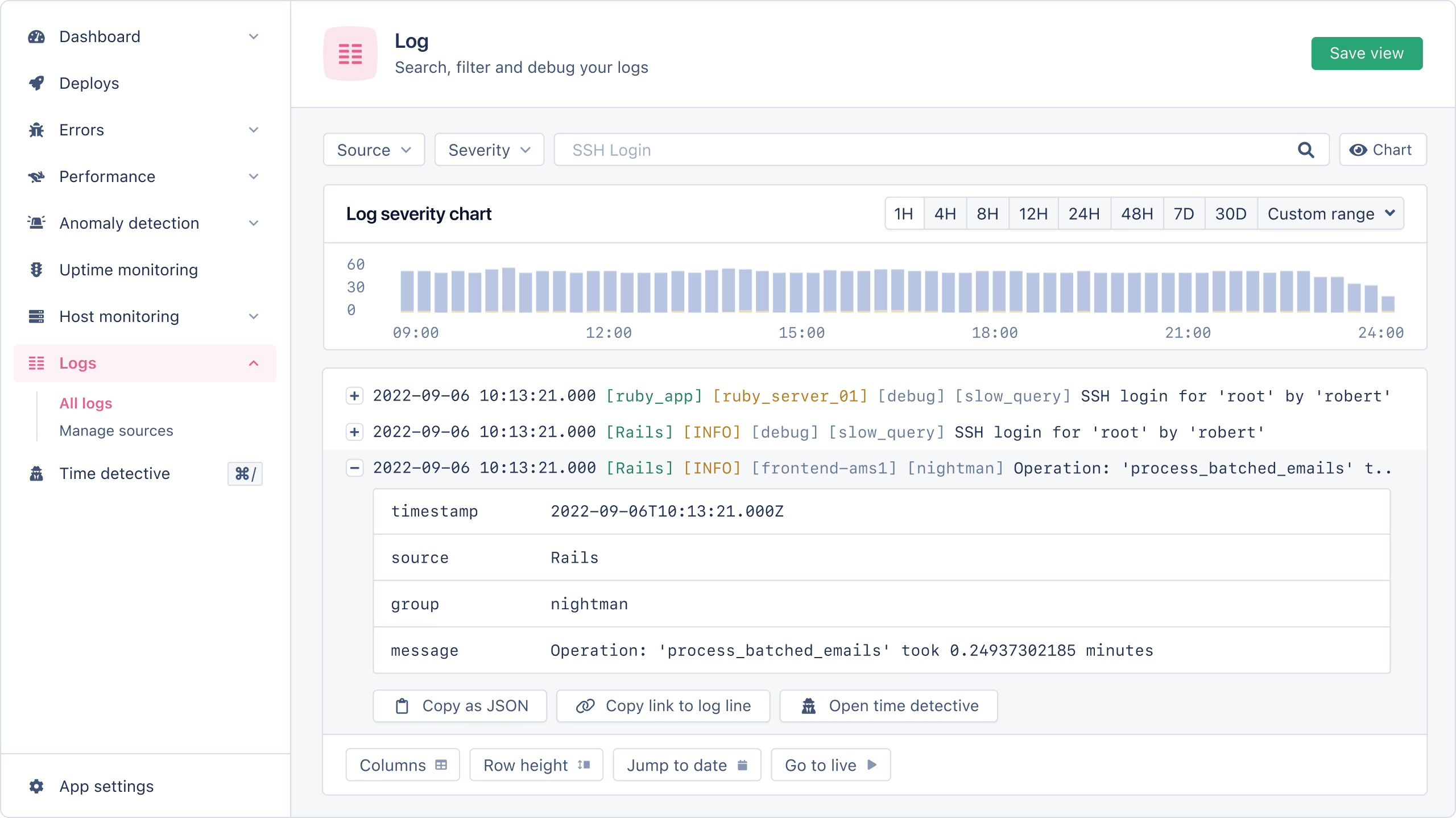
AppSignal is an application performance monitoring (APM) and error tracking tool designed for developers. It offers insight into errors, performance issues, host metrics, uptime monitoring, and logs in one unified platform. It's known for its ease of setup, developer-friendly experience, and real-time alerting.
Key features
Error tracking: Capture exceptions, get alerts, and debug with full request details for your favorite languages like Ruby, Elixir, Python, and more.
Performance monitoring: Track response times, slow queries, background jobs, and memory leaks. Find and fix bottlenecks.
Host monitoring: Monitor CPU, disk, network, and memory usage across your infrastructure. Compare hosts to see which ones are underperforming.
Anomaly detection: Get real-time alerts for any metric or unusual patterns in app behavior from any of the above sources.
Log management: Store and search logs with a clean and intuitive UI. Ingest from any source.
How does AppSignal compare to Sentry?
Main differences between AppSignal and Sentry
- AppSignal has deep support for Ruby, Elixir, Node.js, and Python; Sentry supports 100+ platforms.
- Sentry’s free tier is built around errors/spans/replays; AppSignal’s free plan is request/log–centric (≈ 50k requests, 1 GB logs, 5-day retention).
- AppSignal includes host monitoring for CPU, memory, and disk; Sentry focuses on application-level metrics.
- Sentry is source-available (FSL) and can be self-hosted or used in the cloud; AppSignal is SaaS-only.
Main similarities between AppSignal and Sentry
- Both provide real-time error tracking with detailed diagnostics.
- Both offer performance monitoring and anomaly detection.
- Both integrate with popular deployment and collaboration tools.
- Both are designed for developer-friendly workflows.
Why do companies use AppSignal?
According to reviews on G2, AppSignal is praised for:
Language-focus: Reviewers appreciate AppSignal's support for their favorite languages, like Ruby and Elixir. They say it makes it easier to integrate AppSignal into their existing product.
Ease-of-use: AppSignal is easy to set up and use. It has a bunch of pre-built metrics and visualizations for monitoring their app.
Bottom line
For developers using one of the languages AppSignal supports, it's a great alternative to Sentry. With OTel support and a lightweight free plan, it’s easy to adopt and covers the essentials without extra complexity.
Which Sentry alternative should you choose?
- Want an all-in-one platform that connects errors to user sessions, analytics, feature flags, experiments, LLM observability, and more? Go with PostHog.
- Need simple, reliable error tracking without complexity? Try Rollbar.
- Looking for AI-powered error resolution and strong .NET/Flutter support? Consider Raygun.
- Enterprise-scale observability across your entire stack? Datadog ties everything together.
- Full-stack monitoring with a generous free tier? New Relic is worth exploring.
- Frontend-focused debugging with visual replays? LogRocket excels here.
- Ruby or Elixir shop wanting deep language support? AppSignal is purpose-built for you.
Is PostHog right for you?
Here's the (short) sales pitch.
We're biased, obviously, but we think PostHog is the perfect Sentry replacement if:
- You value transparency. We're open source and open core.
- You want all the tools to help you build a better product (like product analytics, session replays, and A/B testing).
- You want to try before you buy. We're self-serve with a generous free tier.
Check out error tracking install guide and read our docs to learn more.
Tired of reading about tools? Try one.
What if setup took less time than reading this article? Can't speak for our competitors, but that's the case for PostHog.
You can try PostHog today, no strings attached: it's completely free to start, no credit card required, and our setup wizard handles configuration for you in minutes.
One command. AI does the rest.
Frequently asked questions
What is Sentry used for?
Sentry is an error tracking and performance monitoring platform that helps developers detect, diagnose, and fix bugs in production. It captures exceptions with detailed stack traces, groups similar errors, and integrates with developer tools like GitHub and Slack for streamlined workflows.
Why look for Sentry alternatives?
Common reasons include: needing more context around errors, wanting a more generous free tier, consolidating multiple tools into one platform, or finding Sentry's pricing too expensive as you scale.
What's the best Sentry alternative overall?
PostHog is the best all-around Sentry alternative for most teams. It combines error tracking with session replay, product analytics, feature flags, A/B testing, LLM analytics, and surveys, giving you a complete view of both the technical issue and its user impact.
Which Sentry alternatives are open source?
PostHog is fully open source under the MIT license with a public roadmap. Sentry itself is also open source (with a more restrictive license) and offers self-hosting. Most other alternatives like Rollbar, Raygun, LogRocket, and AppSignal are proprietary and cloud-only.
Which Sentry alternative has the best free tier?
PostHog offers 100k free errors/month, plus 1M free analytics events, 5k session replays, and unlimited team members. New Relic offers 100 GB/month of data ingest. Sentry's free tier is limited to 5k errors and 1 user.
Which Sentry alternative is best for frontend debugging?
LogRocket excels at frontend debugging with visual session replays tied to errors. PostHog also offers session replay with error correlation, plus broader product analytics capabilities.
Which Sentry alternative is best for enterprise observability?
Datadog and New Relic are built for enterprise-scale observability, covering infrastructure, APM, logs, and metrics across your entire stack. Both can get expensive at scale, but offer deep visibility into complex systems.
What other error tracking tools are available?
Beyond the tools in this guide, there are many other options worth considering, from simple alerting tools to full observability suites. See our full roundup of the best error tracking tools for a broader comparison.

Subscribe to our newsletter
Product for Engineers
Read by 100,000+ founders and builders
We'll share your email with Substack
PostHog is an all-in-one developer platform for building successful products. We provide product analytics, web analytics, session replay, error tracking, feature flags, experiments, surveys, LLM analytics, data warehouse, CDP, and an AI product assistant to help debug your code, ship features faster, and keep all your usage and customer data in one stack.